A geogrid price with no grade attached is not a price
The single most useful thing to know about geogrid price is that the product is not one product. A 15-15 kN/m biaxial grid and a 300 kN/m uniaxial grid are both "geogrid", and there is a large multiple between them per square metre, because one carries a fraction of the polymer the other does. So a bare geogrid cost figure quoted without the polymer, the strength grade and the roll size tells you nothing you can act on. Every supplier who gives you a low number without those three things is quoting a different product from the one you asked about. Fix the specification first, then collect prices — in that order, the numbers become comparable and the exercise takes an afternoon instead of a month.
What moves the number, in order
Polymer. PP is the base case. HDPE sits alongside it where published creep and durability data are needed. Warp-knitted PET costs more per kN but reaches high strength with published long-term design strength. Glass fibre is priced as a pavement product, not a soil product. Steel-cored composite tracks the steel market as much as the plastics market. Strength grade (kN/m). Within any one polymer this is the main lever, and it is close to proportional — more kN/m means more material in every rib. Mass per unit area. Two grids can claim the same grade and weigh differently; the lighter one has less polymer in it, and that shows up in the price and later in the field. Roll width and length. These decide cutting waste and how many seams the crew makes. Certification and test reports. Third-party testing to a named standard is real cost, and it is why a quote with certificates sits above one without.
The number most buyers forget: container loading
On an export order the freight per square metre is often a larger swing than the difference between two suppliers' ex-works prices, and it is entirely predictable from the product data. A 40HC container takes roughly 180 rolls of 15-15 biaxial grid — about 53,325 m² — but only 90 rolls of 40-40, about 17,775 m², because the heavier grade is thicker on the roll. On the PP uniaxial range a 40HC holds about 55,000 m² of the 60 kN grade and around 8,000 m² of the 260 kN grade. On the PET range, roughly 52,000 m² of the 60 grade down to 7,000 m² of the 800. Same container, same freight bill, seven times the area on the light grade. Before you compare ex-works prices, work out how many containers your quantity needs at each grade — that is where geogrid material cost is really decided on an import.
Per m², per roll or per container — pick one and stay there
Quotation units cause more confusion than any other part of this. Prices are commonly quoted per square metre (the standard for comparison), per roll (convenient for ordering, useless for comparing until you know the roll area) or per container (only meaningful with the loaded area stated). Searches for geogrid cost per square foot, geogrid cost per square yard and geogrid cost per square meter are all the same question in different units — and a price per square foot looks dramatically cheaper than the identical material per square metre, because a square metre is nearly eleven square feet. Convert every offer into one unit before you look at it. Then check the trade term: ex-works, FOB and CIF to your port are three different numbers for the same rolls, and comparing across them is comparing nothing.
Why cheap geogrid is cheap
There is no magic in this industry — the polymer is a commodity and everyone buys it in the same market. When a cheap geogrid undercuts a properly specified one by a wide margin, the saving almost always came from one of three places. Reduced mass per unit area: the same grade name on a lighter grid, which shows up as ribs that stretch further before taking load. Reduced carbon black: the UV stabiliser is a real cost, and below the specified minimum the ribs go brittle during the exposed period before backfill — a grid can be undamaged on delivery and already degraded by the time the fill goes over it. Untested claims: a strength grade printed on a label with no mill test data behind it. None of these are visible on a pallet, which is why the cheapest offer in a bid set deserves a look at the test report rather than an assumption of good luck.
How to compare like for like
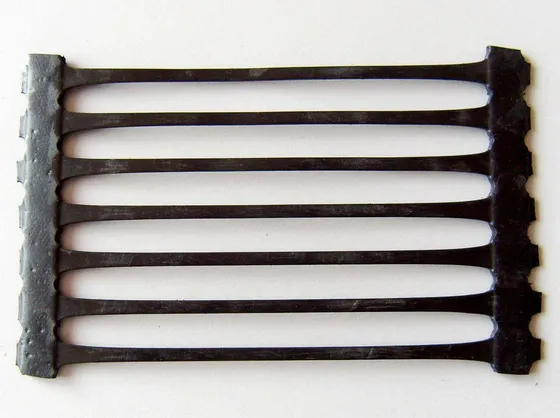
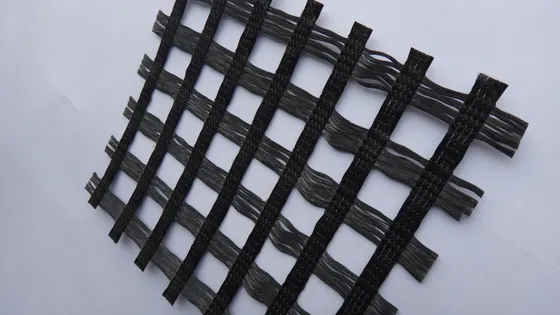
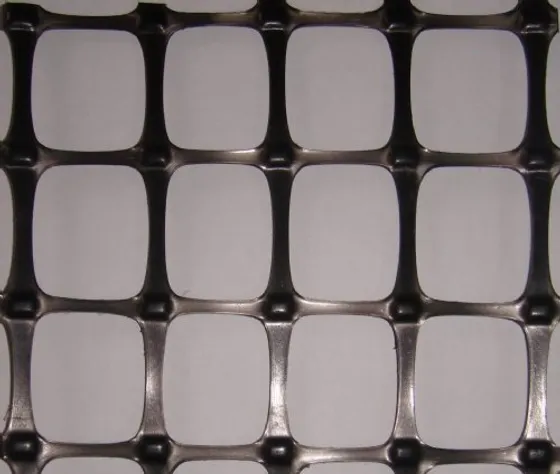
A quotation you can genuinely compare states: polymer and construction (punched-and-drawn PP, punched HDPE, warp-knitted PET, glass fibre, steel-plastic composite); the strength grade in kN/m and the direction it applies to; the tensile strength at 2% and 5% strain; elongation; roll width and length; mass per unit area; and the trade term with destination port. That 2%/5% line is the one that separates a professional comparison from a naive one. Reinforcement layers work at small strain — a stabilisation layer under a road, or a wall layer holding back earth pressure, never gets near ultimate load — so two grids with identical ultimate strength but different strain behaviour are not equivalent products, and the stiffer one may allow a thinner base or fewer layers and cost less overall. Compare at the same grade, the same elongation and the same strain-level tensile figures, or you are comparing labels.
Buying from a manufacturer, and what "near me" gets you
Searching geogrid near me or geogrid for sale finds a local distributor, which is the right answer for a few rolls on a driveway or a small wall — you pay a margin for the convenience of same-week collection, and it is worth it at that size. Above a container load the arithmetic reverses: buying direct from geogrid manufacturers removes a layer of margin and gives you the mill test data for your own batch rather than a generic datasheet. We make the PP biaxial, PP and HDPE uniaxial and PET ranges, and we supply and export the fiberglass and steel-plastic lines from vetted production partners — and we say which is which on the offer, because a geogrid company that will not tell you what it makes and what it buys is not one to build a supply chain on.
Getting a real quotation
Send five things and you will get a firm number rather than a range: the polymer and strength grade (or the design tensile strength the specification calls for), the total area in square metres, the roll width you can handle on site, the destination port, and whether you need third-party test certificates. We will quote PP biaxial geogrid for subgrade and platform work, uniaxial geogrid for walls and slopes, polyester geogrid where a long-term design strength is specified, fiberglass geogrid for asphalt overlays or steel-plastic geogrid where low strain and freeze-thaw durability govern — with a container loading plan so you can see the delivered cost, not just the ex-works one. Where the job also needs separation, woven geotextile and nonwoven geotextile ship on the same consignment. Send the specification and we will come back with a priced offer and the test data behind it.
Free Geosynthetics Spec & Selection Guide
Material grades, thickness/GSM sizing and price ranges for your project — sent to your inbox.


 Geogrid